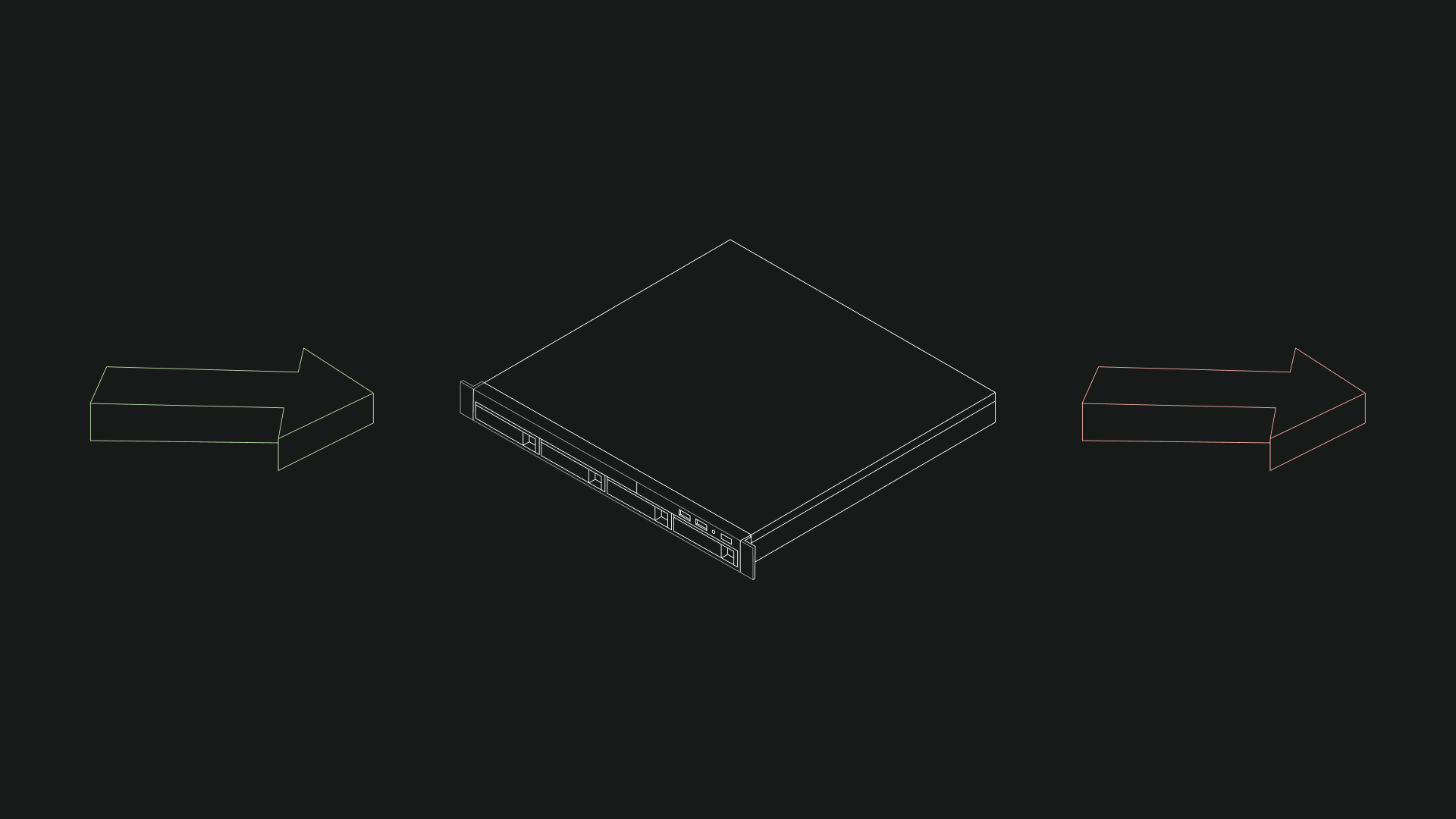
If you've ever deployed on a cloud provider (other than us), you've likely expected one number on your bill, yet saw another. There's a good chance this delta was driven by "bandwidth" or "egress" charges. Egress is a commonly misunderstood line item in cloud spending, and for certain high-throughput workloads (for example, storage) they can easily be one of the most expensive, yet unforeseen costs.
What Are Egress Fees?
Egress fees are charges for moving data out of a provider's network. As your packets move away from your service, you're often billed for the bandwidth this uses. There's also ingress (moving data in), which is almost always free (or at a low cost), causing a confusing asymmetry.
Why High-Throughput Workloads (Like Storage) Get Hit Hardest
When you're moving a certain amount of data from one server to another, or from your server to elsewhere (like a user's device), egress fees get significant. For example, every time you send a 2gb video (this could be a 15-30 minute high quality video) from your server to a user's device, you're using ~2GB of egress.
Storage-heavy and high-throughput workloads are, by definition, moving significant volumes of data.
Some examples of this:
- Media streaming and transcoding pipelines
- Large-scale backup and disaster recovery
- Data lakes for analytics and ML
- Content delivery
- Any dataset(s)
- Any architecture spanning multiple clouds or regions
The whole point of these workloads is data movement. Moving data in, and out. A multi-hundred TB (terabyte) scale dataset that needs to be read, processed, and moved over and over and over can generate egress charges that multiply the actual cost of storing it (this isn't uncommon; teams routinely experience retrieval costs far exceeding their storage costs).
And this only compounds with replication and resilience as data is replicated cross-cloud, cross-region, or using a hybrid architecture because each crossing is a charge.
What We Recommend
For high storage workloads, go with a reasonably billed bandwidth provider (really anywhere you're not checking your invoice daily to make sure egress hasn't torched your budget).
Backblaze: Backblaze is a standout for object storage at scale. They support free egress up to 3x your monthly average storage, with any additional egress priced at just $0.01/GB (incredibly reasonable compared to most cloud providers). That said, if you pair it with Cloudflare as your delivery CDN (thanks to the Bandwidth Alliance) egress becomes entirely free. At $6/TB/month for storage, it's a great option.
Wasabi: Wasabi is based on a flat-rate, no-surprises model. They charge no fees for egress or API requests, you just pay one rate for capacity and nothing for pulling your data back out (within their fair-use policy, where monthly egress stays at or below your stored volume). Pricing starts at $6.99/TB/month, rising to $7.99/TB/month on July 1, 2026.
And of course, Synteq: We built our infrastructure around the principle that your data is yours to move. All plans include 5TB of base bandwidth, with no direct egress charges. For additional bandwidth, we charge $0.00009765625 per GB ($0.10 per TB), and our block storage cost is $3/TB.
The Bottom Line
Watch out for egress fees on high throughput workloads. They can be significant, and are often the deciding factor in total cost of ownership. That teams often treat this charge as an afterthought, and we'd encourage you not to. Before you commit to a provider, model your egress honestly.